You know the feeling. You finished a full day on the tools. Now you're at the kitchen table quoting jobs, chasing invoices, and replying to messages from three hours ago. Your partner asks when you'll be done. You say "ten minutes." It takes two hours.
This is not a time problem. It is a focus problem. Most service business owners spend their best energy on tasks that don't grow the business. The jobs that bring in money get squeezed between admin, follow-ups, and firefighting.
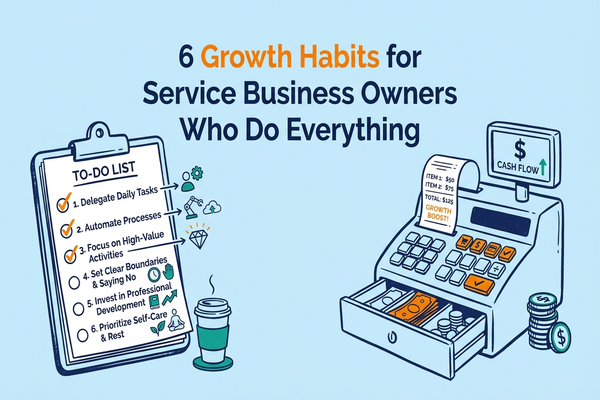
Here are six habits that help you spend more time on what matters and less time on everything else.
1. Sort your tasks into two buckets
Every task in your business falls into one of two buckets. Bucket one: things that bring in money or protect cash flow. Bucket two: everything else.
Quoting a job? Bucket one. Following up a lead? Bucket one. Updating your spreadsheet? Bucket two. Organising receipts? Bucket two.
Most business owners spend 60% or more of their week in bucket two. Flip that ratio and you will see the difference in your bank account within a month.
2. Write down how you do things before you hand them off
You want to hire someone or get help. But every time you try, you end up spending more time fixing their work than doing it yourself.
The fix is simple. Before you hand off any task, write down the steps. Screen record yourself doing it. Save it in a shared folder. Now anyone can follow the process, and you only explain it once.
This is called systemising. It sounds like a big word, but it just means: write down how you do the thing so someone else can do it too.
The rule of thumb? If someone else can do it 80% as well as you, delegate it.
How Do You Know What to Focus on First?
Ask yourself three questions every morning:
- What will bring in money today?
- What protects my cash flow this week?
- What moves the business forward this month?
If a task does not fit one of those three, it can wait. Or someone else can do it.
3. Set up post-service follow-ups
Most service businesses finish a job and move on. No follow-up. No check-in. No review request.
That is a missed opportunity. A simple text message the next day asking "How did everything go?" does three things. It shows the customer you care. It catches problems early. And it opens the door for a Google review.
You do not need to send these by hand. A CRM for service businesses can send them for you, automatically, every time a job is marked complete.
Real-world example: the plumber who stopped chasing reviews
A plumber in Western Sydney was getting one or two Google reviews a month. He set up an automatic follow-up message that went out 24 hours after each job. Within six weeks, he had 14 new reviews. He did not ask for a single one in person. The system handled it.
That is the power of a simple follow-up. One setup. Ongoing results.
4. Build an email list (it is the one audience you own)
Your Instagram followers are not yours. Neither are your Facebook fans. If the platform changes its algorithm or shuts down your page, those people are gone.
An email list is different. You own it. Nobody can take it away.
Start collecting emails from every customer. Send a short update once a month. Share a tip, a seasonal offer, or a reminder to book their next service. Keep it simple. Keep it useful.
Over time, that list becomes one of your most valuable business assets. It costs almost nothing to maintain and gives you a direct line to people who already trust you.
The Australian Small Business and Family Enterprise Ombudsman has free resources on growing and protecting your small business, including guides on digital tools and marketing.
5. Stop doing $30-an-hour work when your time is worth $150
This one is hard for business owners who started as sole traders. You are used to doing everything. Cleaning the van. Booking jobs. Ordering supplies. Doing the books.
But if you charge $150 an hour for your trade, every hour you spend on a $30 task costs you $120 in lost income.
Look at your week. Find the tasks that someone else could do for less than your hourly rate. Bookkeeping. Data entry. Social media posting. Scheduling. These are the first things to hand off or automate.
Your marketing and lead generation should not eat into your billable hours either. Set it up once, or get help setting it up, so it runs without you.
6. Add one new service or revenue stream this quarter
Growth is not always about getting more customers. Sometimes it is about getting more from the customers you already have.
Look at what your customers ask for that you do not offer yet. A mobile mechanic might add pre-purchase inspections. A cleaner might add end-of-lease packages. A removalist might offer packing supplies or storage referrals.
Pick one. Test it for a quarter. If it works, keep it. If it does not, try the next idea.
Diversifying your income protects you when one service slows down. It also gives you something new to promote to your existing customer list.
Wrapping Up
You do not need to work more hours. You need to spend your hours on the right things. Sort your tasks. Systemise before you hire. Follow up after every job. Build an email list. Stop doing cheap work. And add a new service when you are ready.
Pick one habit from this list and start this week. Small changes add up fast.
If you want help setting up follow-ups, marketing, or a system that runs without you, talk to us. It is free. Book a call with our team and we will show you where to start.